Current Projects
We have the following major ongoing projects.
If you would like to work on these topics as a PhD student, postdoctoral researcher or MPhys student, please contact Benjamin.jones-7@manchester.ac.uk.
Single molecules as surface quantum sensors
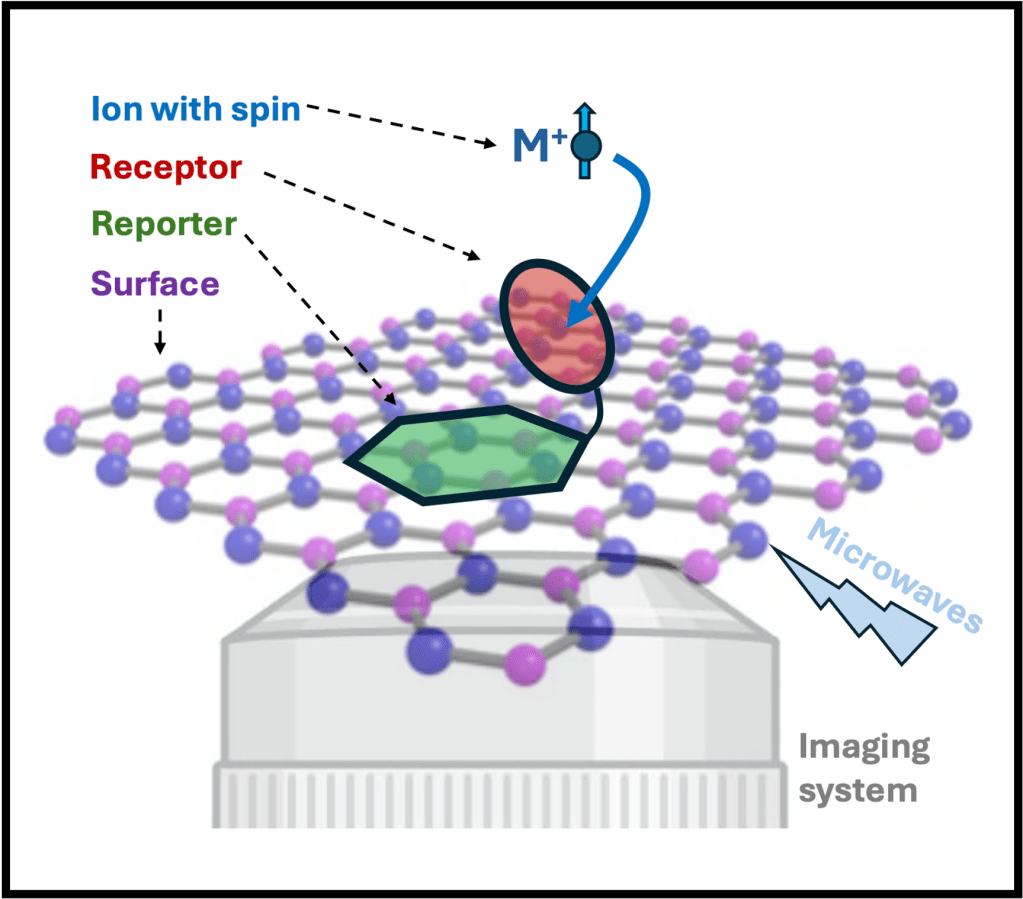
Single molecules on surfaces can be used as tags for single ions at the gas-solid interface. With thoughtful molecular engineering, they can also be used as quantum sensors, taking advantage of their geometric properties and response to optical and radio frequency photons.
Our team is embarking on a campaign of organic molecular synthesis coupled with optically detected magnetic resonance to explore a wide range of applications of single molecules on surfaces for quantum sensing.
Cold atom beams for neutrino mass
The most sensitive laboratory-based searches for a non-zero absolute neutrino mass measure the end-point of the beta spectrum of tritium. Future experiments will require high-flux sources of cold atomic tritium in order to escape from energy smearing effects associated with final-state molecular vibrations.
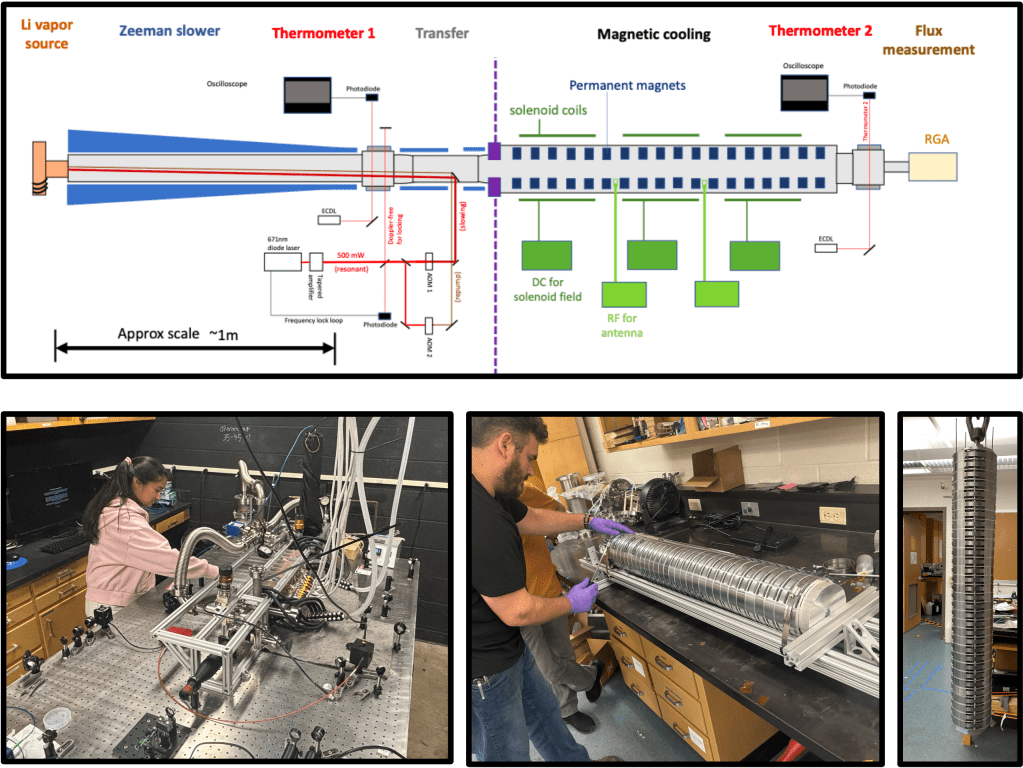
Our team is leading the development of cold atom beams via magnetic evaporative beam line cooling. We have made first-principles theoretical explorations and are pursuing the first experimental verification of the technique using laser thermometry of cold atomic lithium.
PI Jones is also the Atomic Tritium coordinator of the Project 8 neutrino mass experiment.
Single molecule imaging for rare event searches
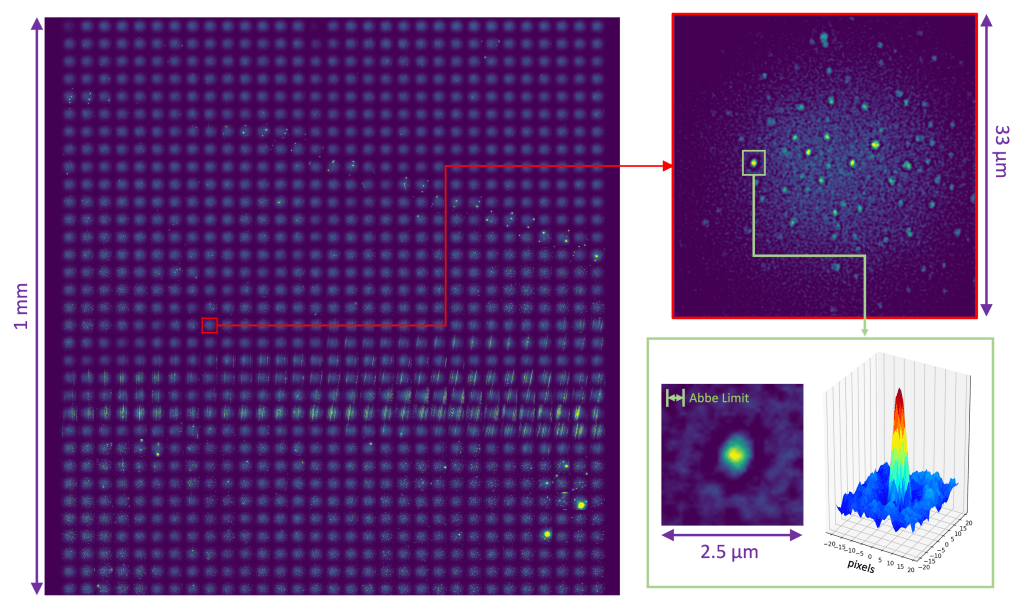
We introduced and demonstrated single Ba2+ imaging using organic molecules as a method to accomplish background-free neutrino less double beta decay searches.
Our past experimental work has demonstrated the first single ion imaging of Ba2+, produced crow-ether-based molecules compatible with solvent less single ion imaging in time projection chambers, created novel microscopes that function at 10 atmospheres of pressure with single Ba2+ sensitivity, and proven radiofrequency carpets for ion transport in high pressure gases.
We are now working to deliver efficient, self-assembled molecular monolayers for sensing daughter ions in noble gases. We are interested in sensing both Ba2+ for neutrinoless double beta decay searches, and S+ and Se+ ions for neutrinoless and two-neutrino double electron capture.
In the Incubator
The following are some examples of projects that are under development:
Superradiant neutrino lasers
Working with collaborators at MIT, we have predicted the onset of a novel kind of neutrino amplification from cold radioactive vapors, leading to a laser-like emission of coherent neutrinos. This work was published in Physical Review Letters and was a Physics Magazine highlight of 2025. We are pursuing opportunities for experimental demonstration of this effect.
Neutrino Physics with Quantum Computers
We demonstrated quantum simulation of neutrino oscillations on publicly accessible IBM-Q quantum computers, and have published quantum algorithmic for extension of the formalism to arbitrary numbers of neutrino species with CP-violation. We are exploring novel applications of quantum computers for advancing simulations in particle physics.
Meta-optics for Particle Imaging
Working with collaborators at Manchester we are exploring the applications of various kinds of meta-optical fabricated devices for atom and particle imaging. Among our areas of interest are meta-optical enhancement of single molecule fluorescence imaging experiments, and 3D VUV track imaging for particle detectors.
Past Projects
Our past projects have included:
Searches for new physics with high energy atmospheric neutrinos

Our group developed a series of searches for new physics using high energy atmospheric neutrinos at the IceCube South Pole Neutrino Observatory. Among the major highlights were:
- A world leading search for eV-scale sterile neutrinos via muon neutrino disappearance [Phys Rev Lett, editors selection]
- The strongest limits on any non-standard neutrino-nucleus interaction channel from any experiment [Phys Rev Lett, editors selection]
- New constraints on decoherence from quantum gravity that advanced sensitivities beyond prior art by factors of approximately 106 [Nature Physics, on the cover]
In order to access the sensitivity needed for these searches, we developed technical solutions to address many challenging systematic uncertainties. The Snowstorm technique is one example, that allows quantification of depth-dependent ice optical model uncertainty and use in analysis.
PI Jones was the Neutrino Oscillations coordinator for the IceCube South Pole Neutrino Telescope.
Development of large high-pressure gas time projection chambers for neutrinoless double beta decay
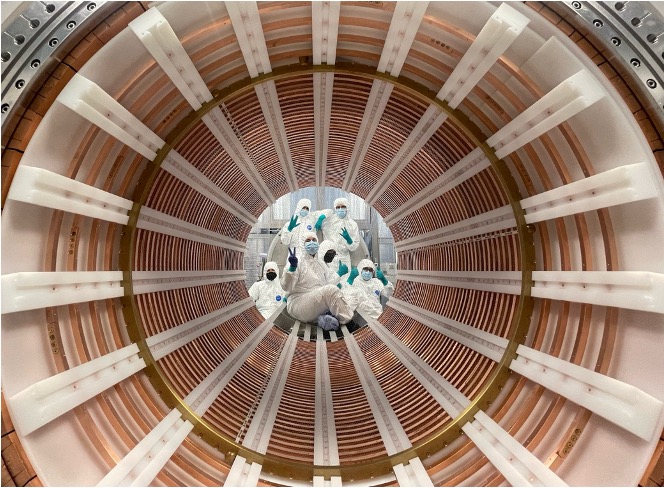
We led US contributions to the NEXT-100 experiment, including delivery of the electroluminescence regions, cathode, high-voltage feedthrough, and collaborative work to deliver the field cage.
We also made contributions to physics analyses with NEXT-White and NEXT-100 with a particular emphasis on Machine Learning and detector microphysics, and led studies of the sensitivity of tonne-scale NEXT modules.
Furthermore, we have pursued a vigorous campaign of time projection chamber R&D including:
- Proposal and demonstration of diffusion reduction using Xenon-4He mixtures
- Exploration of 3He doping to reduce cosmogenic neutron backgrounds
- Development of the PyBoltz simulation package for microphysical prediction of electron drift parameters
- Studies of the distribution of wavelength shifters within TPC experiments to understand anomalous optical response effects
 bjpj physics